Reversal

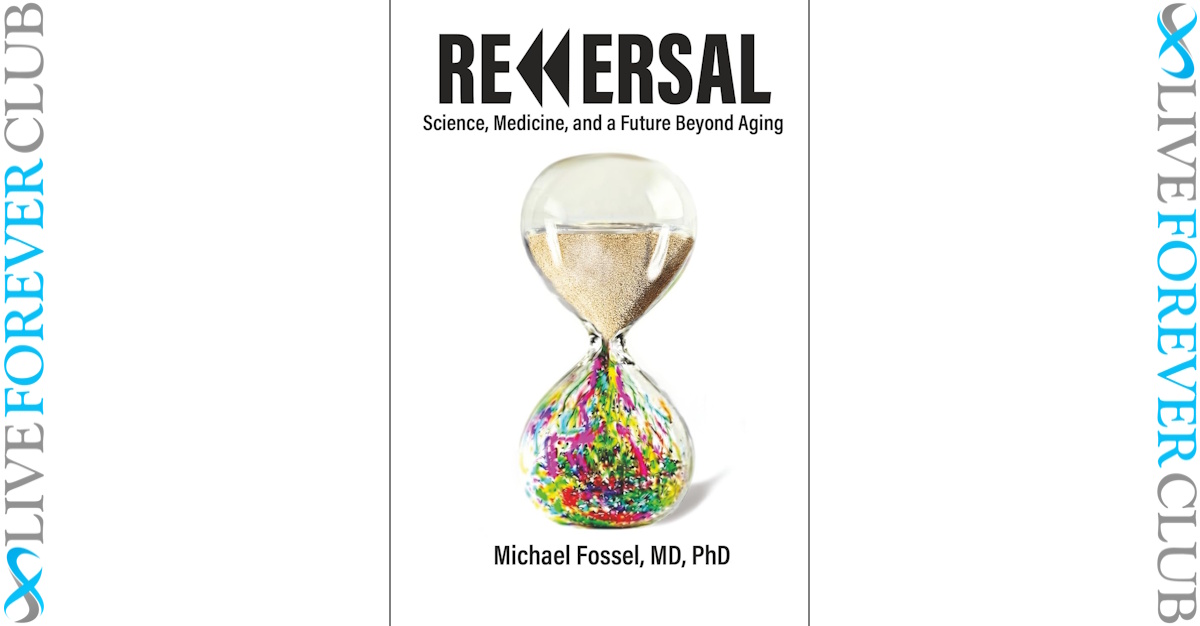
Popular science book by Michael Fossel looking at science, medicine, and a future beyond aging
Aging is not inevitable: it can be reversed.
In Reversal, Dr. Michael Fossel proposes a radical shift: we must stop treating aging as a decline to be managed, and start treating it as a problem to be solved.
The book explains how this central mechanism drives not only aging, but downstream diseases from Alzheimer’s to heart disease and cancer. The solution lies in resetting the aging process at its most fundamental level. Telomerase can relengthen telomeres, resetting gene expression, and restoring the rapid, pristine self-repair of youth. Reversal explains the evidence—from human cells to animal models—showing that we can turn back the biological clock to cure aging and age-related disease at the root. Current approaches to aging and longevity are like treating polio with an iron lung: brilliant technology that manages symptoms but fails to cure the disease.
Reversal Book Review
This is a great book for anyone who is interested in the concept of life extension but doesn’t have any academic knowledge of the subject, or maybe just isn’t interested in the detailed biology. That’s not to say Reversal isn’t based on sound science – Michael Fossel a former professor of clinical medicine at Michigan State University, so definitely knows his stuff. However, he also has a way with words that made some passages as pleasant to read as any fiction.
Where many academics attempting to write for a lay audience fail is their lack of appreciation of the level where the average person’s biology knowledge really sits. Fortunately, Reversal is a true popular science book which doesn’t go into technical detail (or, at least, avoids the technical terminology) using analogies throughout to get his point across. These novel analogies included turning radius, potholes, mass transit systems, ethnic neighbourhoods, and cathedrals… the list goes on! If you’re already familiar with the subject, maybe you’ll find some points repeated with different analogies a bit too much, but for most people, it takes a few repetitions from different angles to really grasp the point.
I had been worried that Fossel, as the author of The Telomerase Revolution, would focus on that on hallmark of ageing, and although he obviously believes they are a key part of ageing, in his own words ‘neither telomeres nor their gradual shortening constitutes the singular “cause” of aging.’ In fact, his approach (“neither upstream risks nor downstream outcomes offer valid targets”) sounded similar to the SENS (strategies for engineered negligible senescence) approach - but he didn’t use this term nor mention Aubrey de Grey.
There still aren’t that many public figures willing to admit being pro life extension but Michael Fossel clearly is expecting radical changes to arrive soon. In this book he also discusses the societal impacts, good and bad, of living longer, though he clearly sees it as a positive opportunity for humankind.
A highly recommended read from an interesting author – so interesting that he just casually mentions that he used to babysit Koko, the gorilla who used sign language, like everyone did something like that when they were younger!
Highlights
Here are 101 key points from Reversal:
- Most current “longevity” interventions could more aptly be branded “short-gevity.”
- True longevity offers not just the chance to cure and prevent age-related diseases but promises to fundamentally transform the nature of human existence.
- From 1900 to 1950, the death rate from infectious diseases plummeted by 90%.
- The leading causes of death today are diseases of old age.
- The impending transformation in understanding and treating aging diseases will echo the revolution in treating infectious diseases over the past two centuries.
- We have saved the young but done nothing for the old.
- This book challenges the notion that our maximum lifespan is an unbreakable barrier.
- Aging isn’t merely an unswerving march toward entropy but is rather a malleable, biologically orchestrated phenomenon.
- While biomarkers can measure how much we age, they do not tell us why we age.
- Genes are the instruments that define the range of melodies a cell can produce, then epigenetics are the tunes they play.
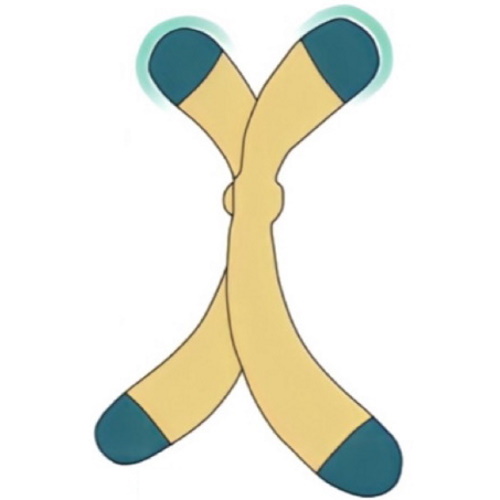
- Unlike an aglet, a telomere is not a passive cap but an active participant in the intricate ballet of cellular aging.
- Aging is complex, which makes intervention simple, at least in principle.
- Definitions alone do not solve problems; they merely name them.
- Aging is a systems phenomenon— an intricate interplay of components, all working together or failing together.
- The difference between youth and old age is not whether damage occurs, but whether your body can keep up with the continual repairs.
- The rate at which your body replaces molecules will determine whether you remain young and healthy or succumb to the ravages of aging and disease.
- If our goal is to reverse aging, merely minimizing damage will never suffice.
- The lifespan of a species is not an accident, but exquisitely calibrated to its ecological niche and, more importantly, to the tempo of its change.
- We age because evolution has honed us for survival, not as individuals, but as a species.
- Possessing two APOE-4 alleles increases risk of Alzheimer’s Disease more than tenfold compared to those with two APOE-2 alleles.
- Damage any part of your body, and you have hastened the onset of age-related disease.
- When cells die, their neighbors take notice, rallying to restore tissue integrity and function.
- Telomeres may shorten, but telomerase ensures that, four billion years later, life marches on.
- Across species, lifespan does not correlate with telomere length, but it correlates almost precisely with the rate of telomere loss.
- It’s not the average telomere that matters, but the shortest telomere.
- Damage and disease increase exponentially over the lifespan, regardless of how long that lifespan is.
- Cells usually age in concert with telomere shortening, but the same outcome can result even without cell division and even without telomere shortening.
- The time has come to pivot decisively from merely treating symptoms of aging to curing aging.
- Cellular aging is probably the crucial shared cause of all dementias.
- Amyloid participates in an endless cellular cycle— continuously produced, secreted, bound, internalized, and broken down.
- Cardiac problems are almost invariably secondary to vascular dysfunction.
- When blood pressure climbs too high, virtually any organ can fall victim to the increased strain.
- In the tiniest capillaries, the vessel wall consists of little more than a single, gossamer-thin layer of endothelial cells.
- Telomere shortening is not merely associated with cardiovascular disease but stands as its herald and harbinger.
- By resetting the functional capacity of all associated cells throughout the vascular system, we might cure and prevent the very diseases that stand as leading causes of death globally.
- Blood levels of oxygen or carbon dioxide that would panic us when acute, become almost tolerable when chronic.
- We can probably cure and prevent most age-related pulmonary diseases by reversing cellular aging.
- Fully half of us over 65 show osteoarthritis in our joints.
- Each profession writes its signature of wear upon specific joints.
- Not only are you continually subject to microfractures (even walking quietly or typing at your desk), but your bone cells are continually “overwriting” these microfractures.
- While evidence confirms that the immune system does age and that inappropriate inflammation characterizes an aging immune system, some researchers overreach when suggesting that all age-related disease ultimately stems from immune system deterioration.
- Chronic low-grade inflammation (“inflammaging“) can jeopardize virtually every organ system.
- The declining precision of immune function impairs the recognition of malignant cells, which increasingly evade detection and develop into clinical and increasingly fatal cancers.
- The more frequent or chronic the infection, the more rapidly the immune system ages.
- In our 60s, fully half of us have noticeable cataracts.
- The amount required to gain (or merely maintain) muscle strength increases with age while muscle recovery slows, and injury risk rises.
- Aging skin is not just a cosmetic issue.
- All the collagen injections, elastin infusions, and skin creams in the world are like painting over the rust in an old car.
- Aged skin becomes so alarmingly thin and fragile that suturing a simple laceration becomes a technical nightmare.
- In almost any species we consider, regardless of how long or how short the lifespan, the rate of cancer parallels the lifespan.
- The body’s surveillance systems— repairing DNA errors and removing cancer cells— grow less vigilant as our cells age.
- Where once we attacked cancer indiscriminately, we now pursue precision interventions based on genetic profiles, molecular vulnerabilities.
- From rodents to primates, restricted feeding consistently extends lifespan.
- Diets are like religions or politics: there is an amazing spectrum of beliefs, but everyone is sure their own belief is the correct one.
- Anything that injures cells accelerates your rate of aging.
- A stressful mind will stress the body, and you will age faster for it.
- Immunizations represent one of your most powerful insurance policies against premature aging and age-related disease.
- Your oral microbiome influences your vulnerability to numerous age-related disease categories.
- While senolytic therapies may demonstrate impressive short-term benefits in multiple tissues, the long-term consequences of triggering compensatory cell division in remaining cells could potentially accelerate tissue aging over extended periods.
- Telomerase activators are at least partially effective at not only elongating telomeres but, more critically, enhancing multiple dimensions of health.
- Aging isn’t entropy; aging is a failure of maintenance in the face of entropy.
- Neither telomeres nor their gradual shortening constitutes the singular “cause” of aging.
- Our goal is not to define a cause, but to choose an optimal point of intervention.
- Telomeres were shown to be an effective point of intervention if we wish to reverse aging.
- As technical hurdles gradually fall away, they give way to regulatory challenges.
- Preventing or curing Alzheimer’s disease would cost substantially less than the enormous costs of providing specialized dementia care.
- What lies on the horizon is not merely a deceleration of aging but its reversal.
- If your parachute fails during a skydive, even perfect telomeres can’t cushion a lethal landing.
- Genetics loads the gun, but cellular aging pulls the trigger.
- While unquestionably age-associated, cataracts are likely to result not from cellular aging but solely from entropic changes to the crystallin proteins within the lens.
- If an “age-related disease” doesn’t fundamentally stem from cellular aging, then telomerase therapy will likely have limited impact.
- Germ cells are not perfect at repairing DNA damage, we simply don’t see those that fail.
- Now, for the first time in human history, we are poised to demonstrate our ability to prevent and reverse nearly all diseases stemming from cellular aging.
- The ultimate victory won’t be our liberation from death, but our liberation from fear.
- Conceptual advances tell us how things work and what needs to be done; technical advances allow us to accomplish those things.
- The most advanced treatment becomes meaningless if it remains beyond reach for most of humanity.
- Prevention and cure scale more efficiently than long-term management.
- AI systems can instantaneously evaluate thousands of potential diagnoses against patient data.
- AI may not replace physicians entirely, but it will certainly supersede those who attempt to practice without AI assistance.
- Robotic surgeons will surpass human capabilities in precision and delicacy.
- Digital Twins can be calibrated specifically to your genetic blueprint and epigenetic markers.
- The coming decades will witness a transformation more profound and rapid than any created by advances in infectious disease.
- Our indication for age-reversal therapy will evolve from treating specific diseases of aging to treating aging itself.
- We should no more accept “healthy aging” than we would accept “healthy Alzheimer’s disease”.
- Telomerase therapy will employ your own body’s existing tools to reset cellular aging.
- Clinically, the implication is that telomerase therapy should be used as early as might appear reasonable (e.g., middle age).
- The earlier we intervene in the aging process, the more we can accomplish.
- Medicine will divide into two fundamental approaches: immediate intervention and long-term optimization.
- Throughout history, when populations swell, we respond by developing better farming techniques, newer crops, better tools, and improved methods to support more people on the same amount of land.
- Just because we can reverse aging and prevent age-related diseases, that doesn’t mean that everyone will live long enough to age.
- Having children is now a choice, and fewer women are so choosing.
- Paul Ehrlich’s influential 1968 prediction of a population “bomb” triggering mass starvation, resource depletion, and widespread poverty proved as misguided as Malthus‘s dire warnings two centuries earlier.
- Longer lives might breed better environmental stewardship.
- A longer, healthier lifespan might offer genuine second chances.
- Extending healthy lifespans would fundamentally alter the cost-benefit equation of human capital investment.
- Whether we can conceive during the first few decades of our lives or potentially across several centuries of extended lifespan becomes a pivotal question for humanity’s future.
- Without exception, the world’s religions focus not on how long we live, but on how well we live.
- If we extend healthy human life, we’re expanding the proportion of our adult lives that we spend in calmer, more reflective decades.
- In the end, living longer won’t make us better people. But it will give us more time to try.
- If there is any rationale for reversing aging, it lies in an unwavering and universal compassion.
- Treating aging is no more “unnatural” than treating an infectious disease or caring for someone with a broken femur.

 See also
Details last updated 27-Apr-2026